

How to size a round coffee table to your sofa, pick a material you won't baby, and style it like a designer — with real dimensions and picks.
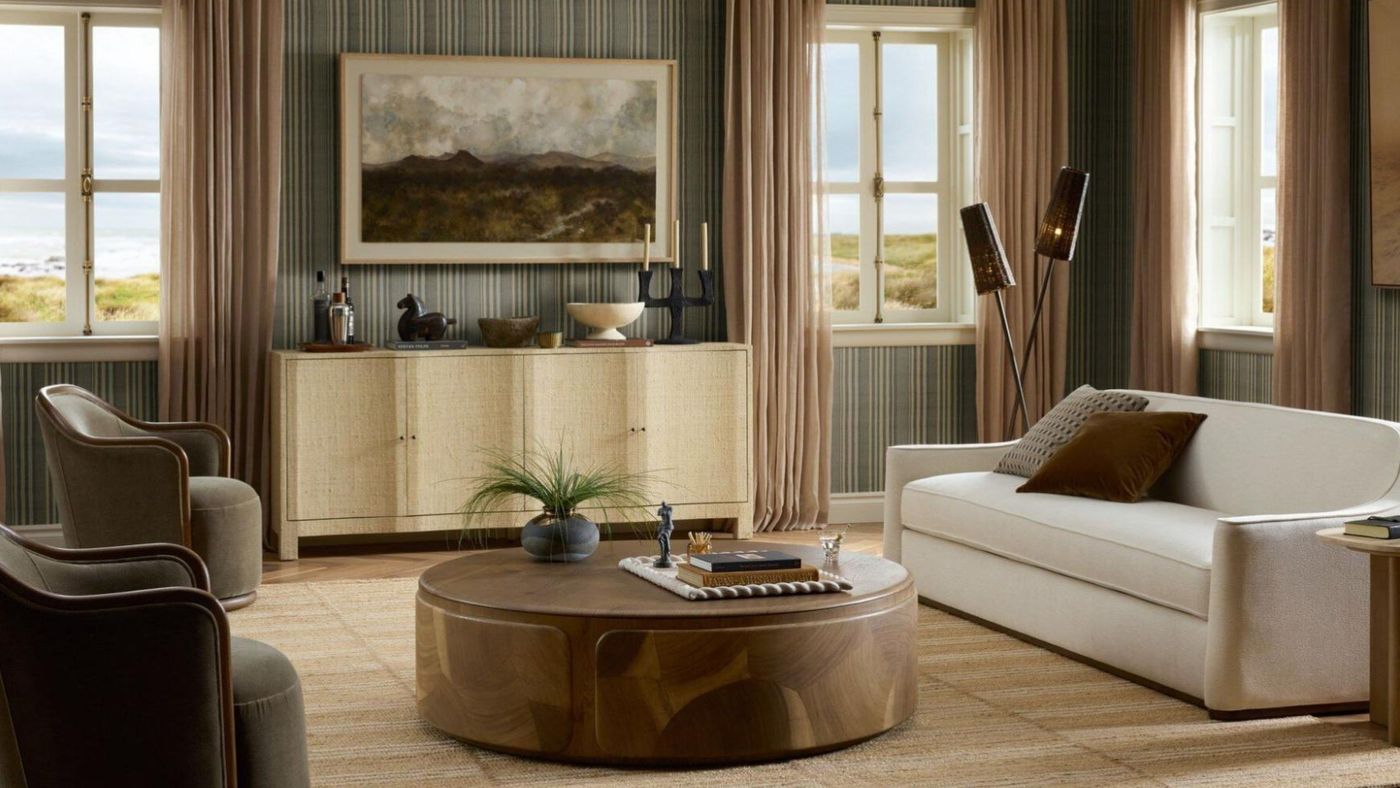
Round Coffee Tables: How to Size and Style One Like a Designer
A round table is the easiest one to live with. Here's how to size it to your sofa, pick a material you won't baby, and style it in one loose vignette that actually holds up.
Quick answer:
To size a round coffee table we recommend picking a diameter about half to two-thirds of your sofa's length, keeping the top within an inch or two of your seat cushions, and leaving 14 to 18 inches between the table and the sofa for legroom. One of the easiest coffee table styling formulas is to create a single vignette. Start with a tray, layer in a few books, add something with height like branches, and finish with one sculptural object. Keep the arrangement to one side so the table still has plenty of room for everyday life.
Why I reach for a round table more than people expect
A round table earns its spot when a rectangle would fight the room. This matters in a smaller living room or anywhere there's a real path between the sofa and the rest of the house. It's friendlier with little kids for the same reason plus there aren’t any sharp edges for a little one to bump their head on. Plus, a round coffee table is more sociable: a circle keeps everyone about the same distance apart, so conversation crosses the table instead of traveling the length of it.
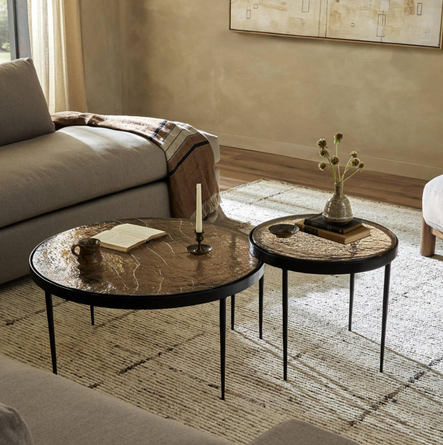
It also does something a rectangle can't. A circle breaks up all the right angles you already have: the sofa, the rug, the walls, and gives the eye a place to rest. That's why a round or soft-edged table nestles into an L-shaped sectional so much more gracefully than a rectangle, which tends to leave an awkward gap in the corner.
Get the size right and everything else gets easier
Coffee table sizing doesn't have to be complicated. Focus on these four dimensions, and you'll end up with a table that feels balanced, functional, and perfectly proportioned.
Diameter vs. your sofa.
About half to two-thirds of the sofa's length. For a standard 84-inch sofa, that's roughly a 36 to 48-inch round. Too small and it looks lost in front of a big sofa; too large and it eats the legroom and feels heavy.
Height relative to the sofa.
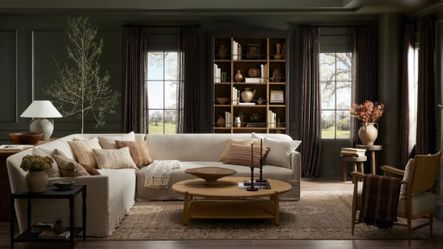
A coffee table should sit level with your seat cushions or 1–2 inches lower. Since most sofas have a seat height of 17–19 inches, a coffee table between 16–18 inches is usually the right fit. Keeping the heights aligned makes the room feel balanced and the table comfortable to use.
Clearance to seating.
Leave 14–18 inches between the coffee table and the sofa. It keeps everything within easy reach while leaving enough room to sit comfortably and move around the space. For main walkways around the table, aim for about 30 inches of clearance.
Scale to the room.
In a smaller living room or apartment, a 30–36-inch round table helps keep the space feeling open. Standard sofas typically pair well with a 36–44-inch table, while larger rooms and sectionals can handle a 44–54-inch drum. If you need more surface area without the visual weight, try two smaller tables instead of one oversized piece.
Coffee Table Sizing Guide
| Your seating | Diameter | Height | Clearance to sofa |
|---|---|---|---|
| Loveseat / small space | 28–34 in | 16–18 in | 14–18 in |
| Standard 78–88 in sofa | 36–44 in | 16–18 in | 14–18 in |
| Large sofa (90 in+) | 42–48 in | 16–18 in | 14–18 in |
| Sectional | 40–54 in (or a pair) | 16–18 in | 14–18 in |
Match the material to your life, not just your look
Pick the material for how the table actually gets used. Here's the short version of what each one asks of you:
Solid or reclaimed wood.
Warm, durable, and forgiving of everyday life. It hides water rings and wears beautifully, requiring little more than coasters and the occasional conditioning. For families with young kids, reclaimed wood is always one of my first recommendations.
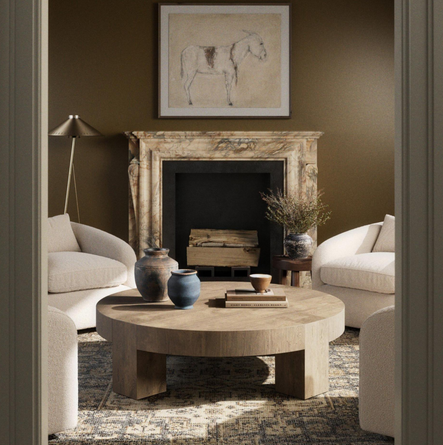
Travertine.
Earthy, timeless, and a favorite among designers right now. More and more homes are embracing stone with natural pits, veining, and texture over highly polished finishes. Because it's naturally porous, seal it regularly and blot spills as they happen. Turkish travertine on a mango-wood base, is where I'd start.


Marble.
Cool-toned, sculptural, and undeniably timeless. It brings an elevated feel to any room but does require a little care. Seal it regularly and wipe up spills quickly, especially wine and citrus, which can etch the surface.
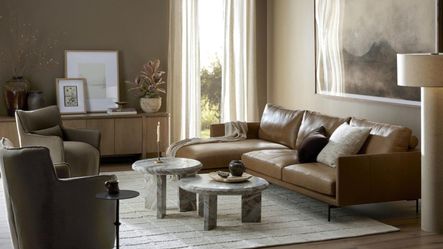
Glass.
Clean, timeless, and visually light. Because it doesn't block the view of the rug or flooring beneath, it creates the illusion of more space while keeping the room feeling bright and open.
Metal or a drum base.
Strong, sculptural, and built to anchor a room. While these designs can feel substantial in a smaller space, they're often exactly what a larger seating area needs to create balance.
One of the easiest ways to make a coffee table feel like it belongs is to repeat its material elsewhere in the room. Pull a wood tone from the flooring, a metal finish from the lighting, or a stone that's already in the space. If that material doesn't exist yet, introduce it through a smaller piece, like a vase, tray, or decorative object. Those subtle connections are what make a room feel cohesive.
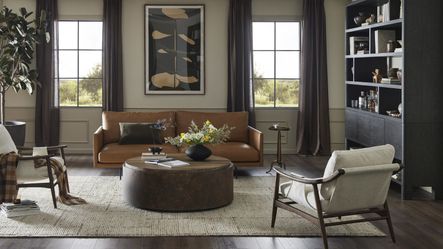
The easy one-vignette formula I use on every round table
A round coffee table is easiest to style with one intentional vignette rather than objects scattered across the surface. Start with a tray, add a short stack of books, something organic with height like branches, and finish with a sculptural object.
- Start with a tray. A tray corrals the remotes and coasters into one honest zone and gives the grouping a base.
- Add coffee table books. Books add a low layer, a pedestal for a small object, and a hit of color. Coffee-table books are the easiest way to get personality onto a table, showcase the subjects you actually love, or set out a family photo album.
- Mix something in tall and organic. Branches, a taper, a stem of greenery in a vase help bring the eye up. Set it slightly off-center so it doesn't read like a dining centerpiece.
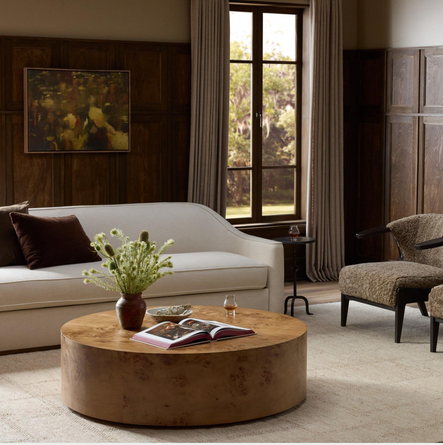
- Finish with a sculptural object. A bowl, a chunk of stone, a small piece — for something to touch.
What I'm really doing under all of that is mixing: a mix of materials, a mix of lines, a mix of heights, a mix of shapes. That's the part where I promise you can't mess up. If it's all smooth, add something rough. If everything's the same height, that's why it looks flat; go tall, medium, low. Black is my cheat code here; it goes with almost anything, so a black object or tray will pull a mismatched grouping together.
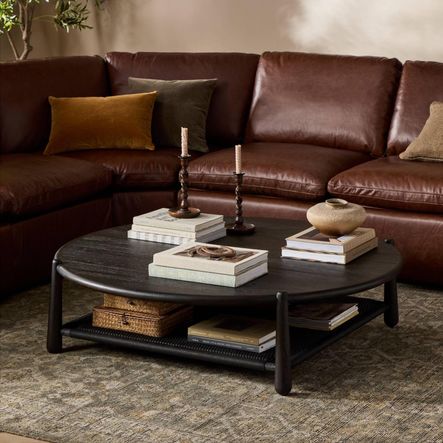
Two things I do every single time. First, I keep the center open, because people put their feet up and set drinks down on a coffee table, that's the job. Second, when it looks done, I take a picture of it. Pictures don't lie the way your eye does. It's like trying on an outfit: you think it works until you see the photo. If the photo looks busy, take one thing off. Almost every room needs editing back, not more added. For the styling logic on any table, not just a round one, here are five tips for decorating a coffee table.
Round or rectangular? How I actually decide
Round coffee tables are a great choice for smaller rooms, family spaces, sectionals, curved sofas, and layouts with tighter walkways. Their soft edges make a room feel easier to move through and help balance spaces with lots of straight lines. Rectangular and oval tables work best with longer sofas, narrower rooms, or more formal layouts where you want additional surface area. If you can't decide, an oval is often the best of both worlds. It offers the length of a rectangle with softer edges that make the room feel more relaxed.
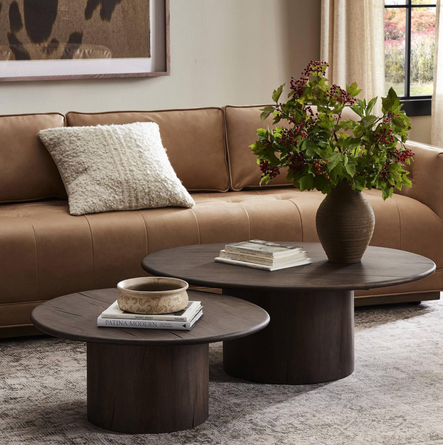
When one table looks lonely: pairs and nesting
A single round table can look stranded in a big or open-plan room. That's the surface trade-off from earlier, and I like three fixes. Use a pair of rounds — slide them apart for everyday, together when you're hosting. Use a nesting set and pull the small one out as an extra drink table when people arrive, tuck it back after; they store flat, which makes them smart for small spaces and rentals. Or keep the small round you love and add an end or side table nearby instead of oversizing. For a sectional specifically, an oversized drum like the Perry, or a pair, fills that inner corner far better than a rectangle. And if you're working a tight budget or a first apartment, a woven piece like the Pascal proves round doesn't have to mean expensive.
Frequently asked questions
What size round coffee table do I need?
Choose a diameter about one-half to two-thirds the length of your sofa. For a standard 84-inch sofa, that's roughly a 36 to 48-inch round. Scale down to 30 to 34 inches for small spaces and up to 44 to 54 inches (or a pair) for large rooms and sectionals.
How tall should a round coffee table be?
Match the table height to your sofa's seat cushions, or go up to an inch or two lower. Since most sofas seat around 17 to 19 inches, most coffee tables fall in the 16 to 18-inch range.
How much space should be between a round coffee table and the sofa?
Leave 14 to 18 inches between the table edge and the sofa front, close enough to reach a drink, far enough for legroom. Allow about 30 inches of clearance where people walk.
Are round coffee tables good for small living rooms?
Yes. With no corners, round tables improve flow and feel less bulky, which makes them ideal for small rooms, apartments, and tight walkways and are safer for homes with young kids.
Round or rectangular coffee table, which is better?
Round is better for small rooms, sectionals, curved sofas, and family spaces; rectangular or oval gives more surface for long, straight sofas and formal layouts. Oval is a popular compromise.
How do you style a round coffee table?
Use a tray as a base, add a short stack of books, one tall organic element, and one sculptural object, grouped slightly off-center with the rest of the surface left open. Vary the heights and keep an odd number of pieces.
Comments
Comment or question? Leave it below.
The full paint story behind the Scout House — from the warm white that anchors the house to the bolder colors tucked into smaller rooms, here's how the Scout House palette came together.
keep reading
How to size a round coffee table to your sofa, pick a material you won't baby, and style it like a designer — with real dimensions and picks.
keep readingHow to choose and style a console table — heights, depths, where to place one, and a designer's styling formula. Shop console tables at Scout & Nimble.
keep reading
How I chose the windows for the Scout House — Marvin's Ultimate Collection, divided lites out front, clean glass out back, and a decade-long partnership.
keep reading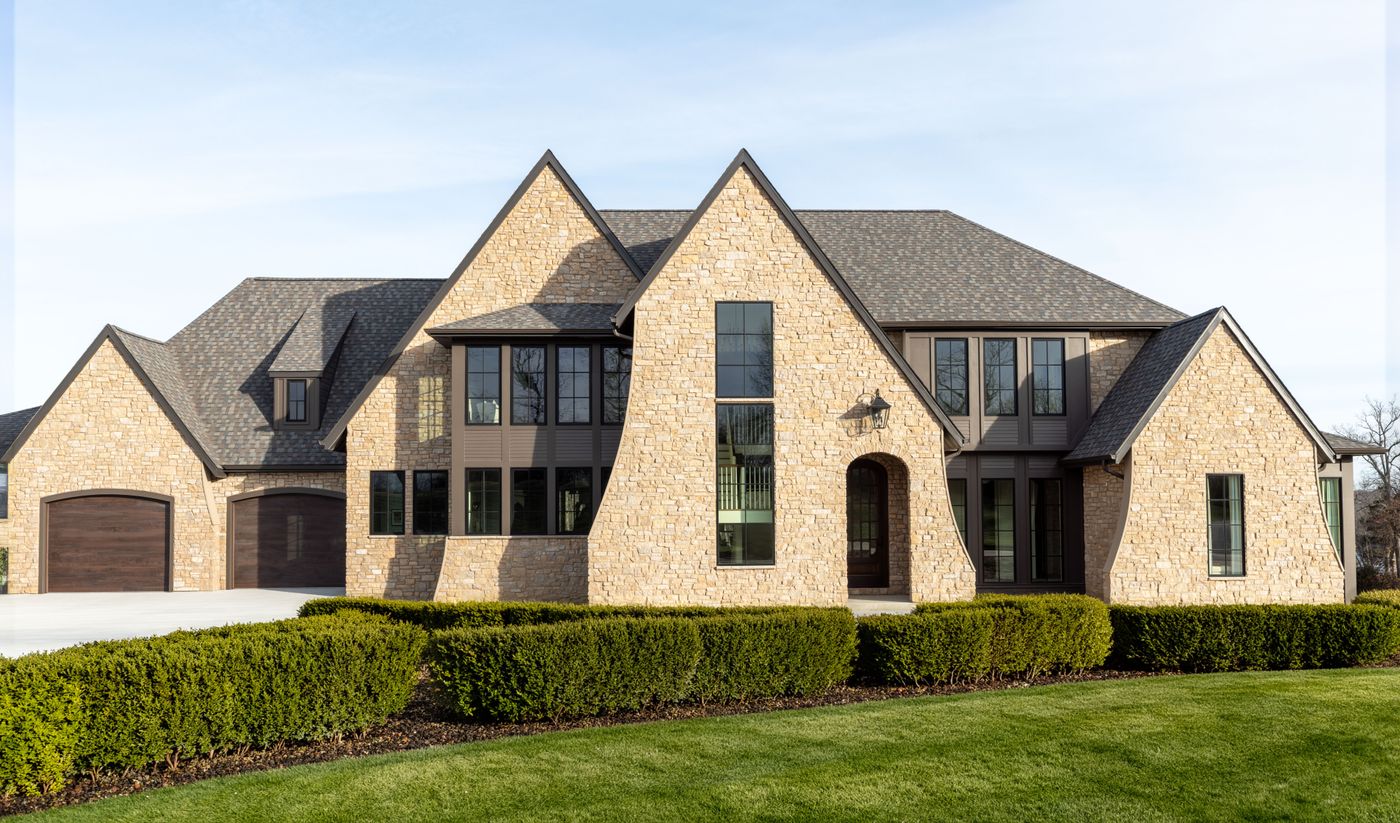
A designer's honest read on 2026 interior design trends, straight from the market floor — the ceramics, glass, and color worth bringing home, and what to skip.
keep reading
The full paint story behind the Scout House — from the warm white that anchors the house to the bolder colors tucked into smaller rooms, here's how the Scout House palette came together.
keep readingHow to size a round coffee table to your sofa, pick a material you won't baby, and style it like a designer — with real dimensions and picks.
keep reading


